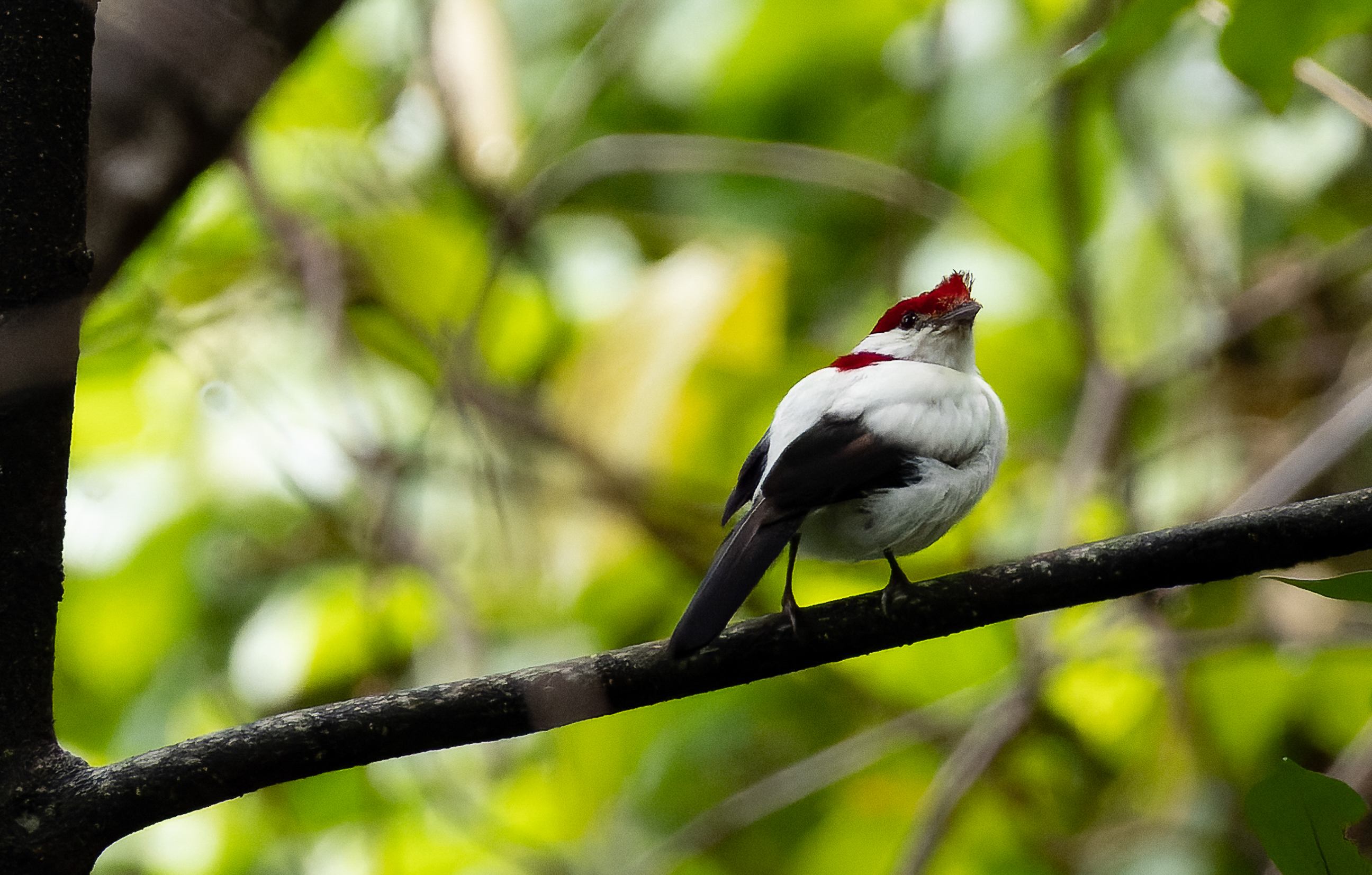
Fewer than 800 individuals. A single river valley. One of the most beautiful birds on Earth.
The Araripe Manakin (Antilophia bokermanni) was unknown to science until 1998. Today it remains one of the rarest and most range-restricted birds in the Americas — and seeing one in the wild is an experience that stays with you long after you lower your binoculars.
If the Araripe Manakin is on your life list, here is everything you need to know about finding it.
What Makes the Araripe Manakin Special
The male Araripe Manakin is unmistakable: snow-white body, jet-black wings and tail, and a brilliant crimson crest that runs from the forehead to the nape. The female is olive-green with a reduced red crest — cryptic enough to disappear into the understorey.
What makes this species remarkable goes beyond looks. It was only described in 1998 by Galileu Coelho and Weber Silva, making it one of the most recently discovered birds in Brazil. Genetic studies suggest the species has low genetic diversity and a declining effective population size — a pattern consistent with a long history of small, isolated populations.
The Araripe Manakin is classified as Critically Endangered by the IUCN. Population estimates range from 150 to 700 mature individuals, with a cumulative decline of about 26% recorded since monitoring began in 2003. The main threats are habitat degradation from agriculture and urban expansion, water diversion from the springs that sustain its forest, and prolonged drought linked to climate change.
Where It Lives — and Nowhere Else
The Araripe Manakin is endemic to a narrow strip of humid forest along the slopes of the Chapada do Araripe, a flat-topped plateau in southern Ceará, in northeastern Brazil. The nearest town is Crato, about 500 km south of Fortaleza.
The habitat is highly specific: spring-fed gallery forest watered by streams that flow down from the Araripe plateau. These ribbons of green are surrounded by dry Caatinga scrub — arid thorn forest that stretches in every direction. The contrast is striking: step a few metres away from the stream and you leave the manakin's world entirely.
The total known range of the species is approximately 28 km of this narrow forest strip. That is it. There is no second population, no backup colony, no other location on Earth.
Where to See the Araripe Manakin
Oasis Araripe Reserve
The primary site for birders is the Oasis Araripe Reserve, managed by Aquasis — the conservation organisation dedicated to protecting the species and its habitat. The reserve is located in the foothills of the Chapada do Araripe, accessible from Crato.
Aquasis runs a small lodge on-site with private rooms and meals. Visits must be arranged in advance. The reserve offers guided walks along the stream-side forest where the manakins breed and feed, and seeing a male displaying in the understorey is a realistic expectation during the breeding season.
Arajara Water Park Area
Another known site is the Arajara area, also in the foothills of the Chapada do Araripe. Some birders have found the species here around the spring-fed streams near the park. Access is less structured than the Aquasis reserve, and conditions may vary.
eBird Hotspot
The Chapada do Araripe is listed as an eBird hotspot. Checking recent sightings before your trip gives you the most up-to-date information on where the birds are being reported.
Best Time to Visit
The Araripe Manakin's breeding season corresponds to the rainy season — roughly October to March. During this period, males are more vocal and active in display, and nesting activity makes them easier to locate along the streams.
The dry season (June to September) is cooler and more comfortable for birding, but the birds are quieter and less conspicuous. If your primary target is the manakin, plan for the wet season and bring rain gear.
That said, the species is resident and present year-round. With a knowledgeable guide who knows the territory, you can find it in any month.
What Else to See in Northeast Brazil
A trip to the Chapada do Araripe is usually part of a broader northeast Brazil birding itinerary. The region holds several other range-restricted endemics that make the journey worthwhile:
- Lear's Macaw (Anodorhynchus leari) — another Critically Endangered species, found in the canyons of Jeremoabo, Bahia. Fewer than 1,700 individuals remain.
- Boa Nova Tapaculo (Scytalopus gonzagai) — described only in 2014, from the transitional forests of Boa Nova, Bahia.
- Grey-breasted Parakeet (Pyrrhura griseipectus) — restricted to a few mountain enclaves in Ceará, including the Serra de Baturité.
- Caatinga endemics — Caatinga Cacholote (Pseudoseisura cristata), White-browed Antpitta (Hylopezus ochroleucus), and several other specialists of the dry thorn forest.
A well-planned itinerary of 10 to 14 days can cover the Chapada do Araripe, Serra de Baturité, Boa Nova, and the Lear's Macaw cliffs — a route that includes some of the most endangered and localised birds on the continent.
Why a Local Guide Matters
The Araripe Manakin lives in a small, fragile habitat. Navigating the access to reserves, knowing the current territories, and minimising disturbance all require local expertise.
Our guide Allan Clé Porto leads expeditions through the Caatinga and Chapada do Araripe. Allan knows the manakin sites intimately — the specific stream sections where males display, the trees where females nest, and the protocols for visiting without putting pressure on the birds.
Booking directly with a local guide means more of your money stays in the region, supporting the communities that coexist with the manakin's forest. And it means a better experience: no rigid group schedule, flexible timing to wait for the bird, and deep knowledge of what else the area offers.
How Your Visit Helps
Ecotourism is one of the most direct ways to support the Araripe Manakin's survival. Revenue from visiting birders funds habitat protection, supports Aquasis conservation programmes, and gives local communities an economic reason to keep the spring-fed forests standing.
Every booking is a vote for conservation. The more birders who come, the stronger the case for protecting the habitat that this species — and the freshwater springs that serve thousands of people — depends on.
See the Araripe Manakin with an expert guide
Explore our Northeast Brazil and Caatinga expeditions — or meet the guide who leads them.
Explore Caatinga expeditions →Plan Your Trip
The Araripe Manakin is not a bird you stumble upon. It requires planning, a guide who knows the terrain, and a willingness to travel to one of Brazil's most remote birding corners. But for birders who make the effort, it delivers something no other bird can: the knowledge that you have seen one of the rarest creatures on the planet, in the only place it exists.
Explore our Northeast Brazil and Caatinga expeditions to see the Araripe Manakin with an expert guide — or meet Allan Clé Porto to learn more about the routes he leads through this extraordinary region.